Skip to navigation
Skip to main content
Skip to navigation
Skip to main content 
NWA Ten Pounds of Gold History: Full Belt Timeline

Before there was a WWE Championship or an IWGP title, there was the NWA Ten Pounds of Gold — the belt that started it all. Nearly 80 years after its lineage began, it remains one of the most storied championships in professional wrestling.
Quick answer: The NWA World Heavyweight Championship was established on July 14, 1948, with Orville Brown as its first recognized champion. The title has used six different belt designs since then, the most famous being the “Ten Pounds of Gold” domed-globe belt introduced in 1973 — a design so iconic it’s still in active use today, with “Thrillbilly” Silas Mason as the current champion as of November 2025.Here’s the full history behind the nickname, every major design change, and what makes this belt different from every other championship in wrestling.
What Is the NWA Ten Pounds of Gold?
The “Ten Pounds of Gold” is the nickname fans and wrestlers gave the domed-globe version of the NWA World Heavyweight Championship — a reference to the sheer physical weight of its gold-plated centerpiece. Unlike titles built around fast-paced storylines, the NWA championship was historically defended under strict, sanctioning-body rules across territories, which is part of why legends like Lou Thesz, Harley Race, and Ric Flair are so closely tied to its legacy.
Origins: The Formation of the NWA (1948)
The National Wrestling Alliance was formed on July 18, 1948, when a group of Midwest promoters led by Iowa’s Paul “Pinkie” George met at the Hotel President in Waterloo, Iowa, to charter the organization. That same night, Orville Brown defended what became recognized as the first NWA World Heavyweight Championship — though the NWA didn’t actually own its own championship belt at the time. Early champions wore modified belts borrowed from other regional titles, since the organization didn’t commission its own belt until 1959.
NWA Belt Design Evolution: Six Belts, One Legacy
The Lou Thesz Belt (1949–1959)
Following Brown’s reign, Lou Thesz became champion and toured internationally with the title — including trips through Japan that helped globalize the NWA name. Thesz actually owned his own championship belt personally during part of this stretch, since the NWA still lacked one of its own.
The First NWA-Owned Belt (1959)
In 1959, the NWA commissioned its first officially owned championship belt, presented to then-champion Pat O’Connor. This marked the first time the organization controlled its own physical title rather than relying on borrowed or personally-owned belts.
The Crown Belt (1959–1973)
The next design became known as the “Crown Belt,” featuring a prominent royal crown above a globe, with “NWA” spelled horizontally across the center behind two wrestling figures. This design was later repurposed for other NWA-affiliated titles, including versions used in Japan and Mexico.
The Original “Ten Pounds of Gold” (1973–1986)
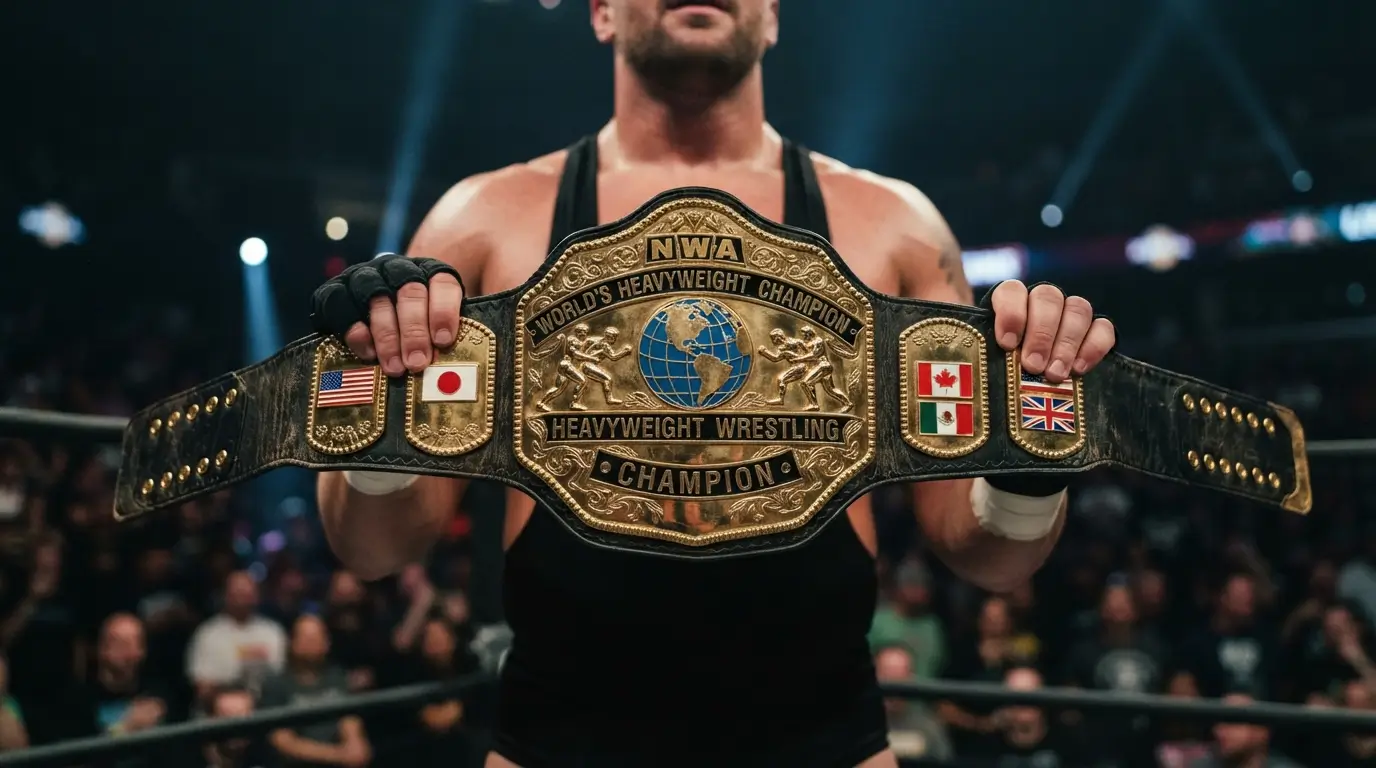
Debuting on May 23, 1973, this is the design most associated with the nickname. Crafted by an unidentified jeweler in Mexico, the belt featured a domed globe centerpiece with the flag of the United States on the main plate, and the flags of Mexico, Canada, Australia, and Japan across the side plates. It originally had a red suede strap and a nameplate — though the nameplate was used only once, by Jack Brisco, before being dropped from later versions. The red strap didn’t hold up well and was soon replaced with black laced leather. This version was defended by legends including Jack Brisco, Terry Funk, Harley Race, and a young Ric Flair.
The Big Gold Belt (1986–1993)
On February 14, 1986, Jim Crockett Promotions introduced a striking new design: three sterling silver plates electroplated in 24-karat gold, crafted by Reno silversmith Charles Crumrine, with cubic zirconia gems set throughout. Ric Flair debuted it on television that same month. This “Big Gold Belt” became so closely associated with Flair that when a contract dispute with WCW arose in 1991, Flair took the physical belt with him to the WWF, sparking a legal fight over who actually owned it. The Big Gold Belt eventually became the WCW World Heavyweight Championship after WCW formally split from the NWA in 1993, and continued representing that title until WCW closed in 2001.
Return of the Ten Pounds of Gold (1993–Present)
When WCW seceded from the NWA in September 1993, the domed-globe “Ten Pounds of Gold” design returned to represent the NWA World Heavyweight Championship — and it’s remained the title’s design ever since, through the promotion’s independent years, its 2017 acquisition by Billy Corgan, and its current era. As of the most recent title change on November 18, 2025, “Thrillbilly” Silas Mason holds the championship, continuing a lineage that stretches back over 75 years.
Why the NWA Belt Still Matters
Unlike championships built around constant title changes, the NWA World Heavyweight Championship has always leaned into scarcity and legacy — long reigns, cross-promotional prestige, and champions expected to represent the title with the same seriousness as a genuine sporting championship. Ric Flair’s record ten reigns with the belt are part of what built his legend, and the design itself — matched almost nowhere else in wrestling — is part of why it’s remained instantly recognizable across generations of fans.
NWA Belt Replica vs. Original: What to Know
Original NWA championship belts are historical artifacts held by past champions or the NWA itself — they’re not available for public sale. Replica quality on the market varies significantly:
| Feature | Budget Replica | Premium Replica |
| Plate material | Thin stamped metal | Zinc alloy plates, 2mm–4mm thick |
| Finish | Painted gold | 24kt gold electroplating |
| Strap | Faux leather | Genuine hand-tooled leather |
| Detailing | Flat printed design | Hand-etched centerpiece and side plates |
| Typical price | Under $130 | $150–$250+ |
Quality NWA replicas typically use zinc-alloy plates between 2mm and 4mm thick, hand-etched and electroplated in 24-karat gold, mounted on genuine leather straps — details that closely echo the craftsmanship of the original domed-globe design.
Shop the NWA Ten Pounds of Gold Replica at Our Shop
If you want to bring this legacy home, our NWA Belt collection is built around the iconic domed-globe “Ten Pounds of Gold” design that’s defined the championship since 1973. Every belt we make uses zinc-alloy plates between 2mm and 4mm thick, hand-etched detailing, 24kt gold electroplating, and a genuine leather strap — with full customization available if you want a nameplate or personalized finish. Whether you’re a longtime NWA fan or just discovering wrestling’s original world title, our shop is where you can own a piece of this near-80-year legacy.
FAQs
When was the NWA World Heavyweight Championship first established?
The title dates back to July 18, 1948, when Orville Brown became the first recognized champion following the formation of the National Wrestling Alliance in Waterloo, Iowa.
Why is it called the “Ten Pounds of Gold”?
The nickname refers to the domed-globe belt design introduced in 1973, whose gold-plated centerpiece was notably heavy compared to other championship belts of the era.
How many different NWA belt designs have there been?
The championship has used six distinct designs: the early borrowed MWA belt, the Lou Thesz belt, the first NWA-owned belt (1959), the Crown Belt, the original Ten Pounds of Gold (1973), and the Big Gold Belt (1986–1993), after which the Ten Pounds of Gold design returned permanently.
What is the difference between the NWA belt and the Big Gold Belt?
The Big Gold Belt was a separate design introduced in 1986, later becoming the WCW World Heavyweight Championship. The original domed-globe “Ten Pounds of Gold” returned as the NWA’s title design in 1993 and remains in use today.
Who is the current NWA World Heavyweight Champion?
“Thrillbilly” Silas Mason became champion on November 18, 2025, at the NWA’s 77th Anniversary Show.
What materials are used in a quality NWA belt replica?
Well-made replicas typically use zinc-alloy plates between 2mm and 4mm thick, hand-etched and finished with 24kt gold electroplating, mounted on genuine leather straps.
Conclusion
From a borrowed belt in 1948 to the iconic domed-globe design that’s defined the title since 1973, the NWA Ten Pounds of Gold carries a legacy no other wrestling championship can claim — it’s the original. Nearly 80 years and six belt designs later, it’s still being defended today, connecting modern champions like Silas Mason directly back to legends like Lou Thesz and Ric Flair.
Explore our NWA Belt replica collection to own a piece of wrestling’s original world championship.