Skip to navigation
Skip to main content
Skip to navigation
Skip to main content 
ECW Belt History: Complete Championship Design Guide

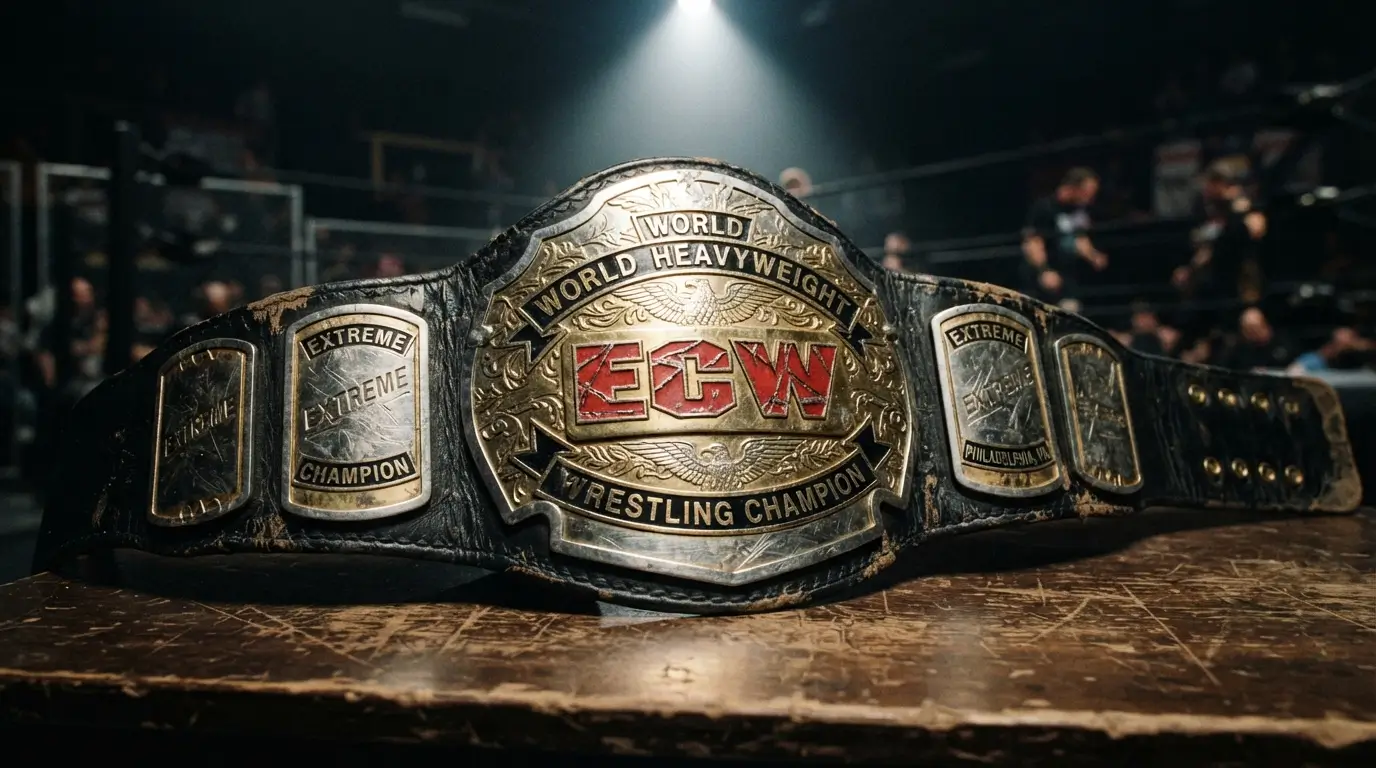
Few championship belts carry the raw, rebellious identity of the ECW Belt. Born out of a scrappy regional promotion in 1992, it evolved through five major redesigns before becoming one of the most recognizable titles in professional wrestling history.
The ECW Belt was first introduced on April 25, 1992, under Eastern Championship Wrestling, with Jimmy Snuka as its inaugural champion. Over the next 18 years, the belt went through five major design changes — from a five-plate regional title to WWE’s phoenix-emblazoned 2008 version — before being retired on February 16, 2010.Below, we break down every era of the ECW Belt’s design, what made it stand apart from other promotions’ titles, and what to look for if you’re buying a replica today.
What Is the ECW Championship Belt?
The ECW Championship Belt was the top title of Extreme Championship Wrestling (ECW), a promotion famous for hardcore, high-risk matches and a gritty, anti-establishment attitude. The belt itself mirrored that identity — barbed wire motifs, aggressive typography, and a design language that broke from the polished look of WWE and WCW titles of the same era.
The title changed hands through three distinct organizational phases: Eastern Championship Wrestling (1992–1994), Extreme Championship Wrestling (1994–2001), and WWE’s revived ECW brand (2006–2010).
Eastern Championship Wrestling (1992–1994)
The first version of the belt debuted on April 25, 1992, when Jimmy Snuka won a battle-royal final to become champion. Belt-maker Mike Vartanian crafted this original five-plate design, closely modeled on the Tri-State Wrestling Alliance’s heavyweight title — the promotion ECW grew out of.
The centerpiece featured geographic outlines of Pennsylvania, New Jersey, and Delaware picked out in blue, with an eagle separating the words “Heavy” and “Weight” at the top. It was a regional title through and through, reflecting the promotion’s Tri-State roots rather than any global ambition.
ECW Belt Design Evolution: A Full Timeline
1996 Redesign: The First “World” Title Look
When Eastern Championship Wrestling rebranded as Extreme Championship Wrestling in 1994, the original belt stayed in use until December 1996. The new design introduced a black leather strap with snap fasteners, five gold-plated pieces, a crown-and-globe centerpiece resembling the NWA’s “Big Gold Belt,” and the words “World Heavyweight Wrestling Champion” prominently displayed. A barbed-wire ECW logo in red sat above the globe, while the side plates carried the flags of Mexico, Japan, the United States, United Kingdom, Canada, and France — signaling the promotion’s growing international ambitions.
1998 Redesign: The Iconic Joe Marshall Belt
In May 1998, designer Joe Marshall created what many fans consider the definitive ECW Belt. It kept the five gold-plated pieces but added a crocodile-skin pattern on the inward-facing strap, a chain-link fencing texture across the centerpiece, and baseball bats wrapped in barbed wire flanking a blue globe. The violet ECW logo and deliberately “bleeding” text treatment on “Heavyweight Wrestling” gave the belt an unmistakably hardcore visual identity — this is the design most associated with ECW’s late-’90s peak.
2006 WWE Revival Belt
After ECW folded in 2001, the title stayed dormant until WWE relaunched ECW as a third brand in 2006. The revived belt kept the 1998 design’s DNA but updated it with a full black leather strap featuring barbed-wire tooling along the edges, and swapped the violet ECW logos for red ones.
2008 Redesign: The Final ECW Belt
On July 22, 2008, WWE General Manager Theodore Long unveiled the final ECW Championship design. Machined and assembled by André Freitas’ AFX Studios, this version used five platinum-plated pieces on a larger black leather strap. Its centerpiece depicted a phoenix rising over a globe, with the WWE logo above and a removable nameplate engraved with the champion’s name below. A jagged, saw-like border ran around the entire piece. This design remained in use until the title — and the ECW brand itself — was retired on February 16, 2010, with Ezekiel Jackson as the final champion.
Beyond the World Title: Other ECW Championship Belts
The World Heavyweight Championship wasn’t the only title in ECW’s history. The promotion also crowned champions for:
- ECW World Tag Team Championship — introduced in 1993, held by teams like The Public Enemy and The Dudley Boyz
- ECW Television Championship — a secondary singles title for the promotion’s TV-era stars
- ECW Pennsylvania State Championship — a short-lived regional title from 1993
- ECW Maryland Championship — another regional offshoot title
Each carried its own plate design, generally echoing the World Title’s aesthetic while scaling down the scope to match its regional or divisional status.
What Makes the ECW Belt Design So Distinctive?
Compared to the polished, symmetrical belts of WWE and WCW in the same period, the ECW Belt leaned into asymmetry and grit — barbed wire, jagged edges, and deliberately rough typography that matched the promotion’s “extreme” branding. It’s part of why the belt remains a favorite among collectors and replica buyers decades after ECW’s original run ended: it looks like nothing else in wrestling history.
ECW Belt Replica vs. Original: What’s the Difference?
If you’re looking to own a piece of this design history, you’ll be buying a replica rather than an original — surviving originals are either in WWE’s archives or private collections and are not for sale. Here’s what separates a well-made replica from a cheap knockoff:
| Feature | Budget Replica | Premium Replica |
| Plate material | Thin painted metal | Zinc alloy or brass, 2mm–4.5mm thick |
| Strap | Faux leather | Genuine cowhide leather, ~4mm thick |
| Fit | Fixed size | Adjustable, fits up to 46″ waist |
| Detailing | Flat printed logos | CNC-machined or hand-etched plates |
| Customization | None | Nameplate engraving, custom logos |
| Typical price | $100–$150 | $150–$250+ |
Most quality ECW belt replicas on the market today use zinc-alloy or brass plates between 2mm and 4.5mm thick, mounted on genuine cowhide leather straps around 4mm thick with snap-fastener adjustability — details that directly echo the craftsmanship of the original 1998 and 2008 designs.
How to Choose an ECW Belt Replica
If you’re buying rather than just reading about the history, a few things matter more than price alone:
- Plate thickness and material — zinc alloy or brass plates in the 2mm–4.5mm range hold detail and shine far better than thin stamped metal.
- Strap quality — genuine cowhide leather ages well and holds snap fasteners securely; faux leather cracks over time.
- Customization options — if you want your name, a promotion logo, or a dedication engraved, confirm this is offered before ordering.
- Which era you want — decide whether you’re after the 1998 “barbed wire” look, the 2008 WWE phoenix design, or a stylized modern take, since sellers often offer multiple versions.
Our ECW Belt replica collection includes zinc-plated, fully customizable designs built on genuine leather straps — a solid middle ground between budget knockoffs and $500+ official retail pricing.
FAQs
When was the ECW Championship belt first introduced?
The ECW Belt debuted on April 25, 1992, under Eastern Championship Wrestling. Jimmy Snuka became the inaugural champion after winning a battle-royal final, receiving a five-plate belt crafted by Mike Vartanian.
How many different ECW belt designs have there been?
The title went through five major redesigns between 1992 and 2010: the original 1992 belt, the 1996 “Big Gold”-style version, the iconic 1998 Joe Marshall design, the 2006 WWE revival belt, and the final 2008 phoenix design.
What materials are ECW belt replicas made from?
Quality replicas typically use zinc-alloy or brass plates between 2mm and 4.5mm thick, mounted on genuine cowhide leather straps around 4mm thick with adjustable snap fasteners.
What’s the difference between an ECW replica and the original belt?
Original ECW belts from 1992–2010 are either retired in WWE’s archives or held in private collections and aren’t publicly sold. Replicas recreate the design using modern materials, and quality varies significantly based on plate thickness, strap material, and craftsmanship.
How much does an ECW belt replica cost?
Prices generally range from $130–$250 for well-made replicas with metal plates and leather straps, while officially licensed WWE shop replicas can run $500 or more.
Can I customize an ECW belt replica?
Yes — most replica makers offer nameplate engraving, custom logos, and sizing adjustments, though options vary by seller.
Conclusion
From its scrappy 1992 debut under Eastern Championship Wrestling to the phoenix-emblazoned design that closed out the ECW brand in 2010, the ECW Belt’s history is really a story of an underdog promotion using its championship as a statement — barbed wire, jagged edges, and all. Five major redesigns later, that raw identity is still what makes the belt instantly recognizable to wrestling fans today.
Whether you’re here to relive that history or to bring a piece of it home, a well-made replica — with the right plate thickness, genuine leather strap, and customization options — is the closest you’ll get to owning that legacy. Browse our ECW Belt replica collection to find the design and era that fits your collection best